Friday, May 7, 2010
Mikhail Gorbachev and the Collapse of Communism
The Collapse of Communism

Thursday, April 29, 2010
Nelson Mandela And Aparthied
Wednesday, April 28, 2010
African Independence
Wednesday, April 14, 2010
Film Lesson: "The Right Stuff"
I found this movie to be very entertaining from its comedy and the plot itself. The back and forth competition between the U.S. and Russia was intriguing. For the most part of the movie I liked how it was more of a "I'm better than you" or "I can do this can you?" kind of relation between the two countries. Sure this was a serious time period in real life but in the movie the script apparently had a lot of room for some humor. For example the multiple shuttle launches until they we're finally successful. One of which didn't even get off the ground was hilarious because well for one it didn't blow up.
Monday, April 12, 2010
NATO and The Warsaw Pact
NATO stands for North Atlantic Treaty Organization, which consisted of 28 countries. The countries within this organization were mainly the United States, Canada, and several Western European Countries. This organization was made after World War II and it was to provide aid for countries in need. Especially during a time right after WW2 European Countries were in dire need of aid. This organization could also work in a way as if one country needed help then others within the organization can help out.
Tuesday, March 23, 2010
Film Lesson: "Schindler's List"
Though this a Hollywood production it is very polished off and stays true to the meaning of the movie. Like "Night and Fog" there are very graphic scenes and unlike the documentary the actions taken towards the Jews are shown. The documentary only showed the results but not what lead up to them. Like all movies this was also plotted out but Spielberg tried to make it as realistic to the truth as possible. The difference between this film and the other mentioned above is because in this one you get to see the Jews talk and speak and see their reactions to what was going on. Sure it was scripted like I said but at least it was a very good of portraying emotions. If your a critic of movies and very critical on them then don't even bother saying a negative comment on this movie. Not only does it have everything it needs to be a good movie but it take place during a real event.
Film Lesson: "Night and Fog"

Wednesday, February 24, 2010
The Treaty of Versailles (ended WWI)
On June 28th of 1919, The Allied Powers and Germany signed the Treaty of Versailles. This Treaty brought up many important details on everything from on who’s to blame to how things are going to be different in Europe. By having Germany sign the treaty in the Palace of Versailles (hence the name) in the winners territory also showed easily Germany went along with this. This treaty marked the end of WWI. Germany signed a treaty that put all the blame on them for damage and casualties caused in this war. Not only that but Germany military size got limited to 100,00o men and a maximum of 6 naval battleships. Germany couldn't have submarines or an air force either. All of these statements in the treaty piled up for as Germany also had to pay for the entire damage not just take the blame for it. To make matters worse all the countries Germany had control of were released from their grips. The territory Germany claimed in Africa during the age of imperialism was withdrawn.
Though I do blame Germany for being extremely brutal in wars not only because they are very well organized and deadly but making them pay for all the repercussions wasn't the right thing to do. As for reparations go of £6,600 million really made their economy declined so much that I doubt they were able to support themselves while paying off their debts. Also let’s not forget that other countries were involved in this war and the spark of this war began when the assassination of the archduke took place. As far as payback goes I believe the rise of Fascism signified the beginning. Adolf Hitler saw the Treaty of Versailles as discrimination and un-rightful punishment towards the Germans. In fact Germany did have the most casualties, why were they taking all the blame for this.
By adding insult to injury Germany also lost 10% of its land. Austria and Turkey also signed different treaties which made them both new countries even though they lost land, they didn't face the same repercussions like Germany. I don't blame Germany in the end thought the Treaty of Versailles was a bit harsh. I mean wasn't Germany just standing up for Austria once the archduke was killed. Maybe things would have been different if this treaty wasn't so rough towards the Germans. I still think Hitler would have gone into power in some way knowing how clever he was but I think European history would be a lot different if it wasn't for the Treaty of Versailles.
Tuesday, February 23, 2010
Mustafa Kemal (Ataturk) and the modernization of Turkey
Mustafa Kemal was known as "The Father of Modern Turkey." He brought changes to Turkey after WWI when the Allied Forces were victorious and the split of the Ottoman Empire. Not only was he considered the above title but also seen as the George Washington of Turkey. He was the first president of the country for 15 years. Kemal was also given the name "Ataturk" which means father Turk. Although he was given that name doesn't mean it came easily. He had to first make some changes in Turkey. Mostly secular which in this case means more modern less religious. He believes that the people of Turkey should first start dressing more like the people of Europe rather than what their religion says. He doesn't want them to be stuck in the past. One of the changes he made that was secular and that to do with his people appearance was the Fez. The Fez was a hat that men of the Muslim religion wore. Kemal called those people uncivilized for wearing a Fez that it is not a real hat. They should wear something that is actually a hat. As for women, he wanted them to stop wearing a veil.
The thing that made Kemal different from other leaders was that he let people practice their religion. The Ottoman Empire was special because it was a fully Muslim nation. After Kemal came into scene things changed. Kemal also cared for the peasants. The peasants finally became important within society because in the Ottoman Empire they were really forgotten. Overall Kemal brought multiple changes to Turkey that mimicked the western world whether it is clothes or way of life. That is why he is known as what he was "The Father of Turkey."
Thursday, February 11, 2010
Film Lesson: "Gandhi"
In 1869 one of the world’s most important/inspirational people was born. His name was Mohandas Karamchand Gandhi. He was given the nickname "Mahatma" which means great soul. Indeed he was a great soul for all of his actions did believe in the act of violence. He was a peaceful soul himself. Gandhi was very intelligent well educated person that knew a lot about Law from his studies in London. This allowed him to succeed in his plans for India's independence in the future. Speaking of India's independence, Gandhi was one of the people to go against the control of Great Britain and lead his country to freedom. In doing so also led to his death, but that was due to religious reasons.
I liked the way Gandhi actually worked things out but the one thing I didn't like was the fact that many people on his side had to die and get hurt from his side. In the end that was the only way. His famous quote "an eye for an eye will make the whole world blind" is famous for a reason. That reason is the backbone of his actions. Hammurabi's "an eye for an eye" system was a violent system which could lead to physical problems. Gandhi thought that back and forth violence between both countries would only make both look bad.
Not only did Gandhi devote his life into gaining independence from Great Britain but also making all of India understand how to get it. He had to teach them that peaceful actions and taking blows from the enemy only shows who the bad guy is. A lot of them didn't understand that and thought about fighting fire with fire. Gandhi was ashamed of them for doing so because that is not the way he planned it. I see his plan with peaceful protests as more of a mind game. He wants to get in the head of the British government and show them that he doesn't care if dies for his country but as long as they see what they are doing and stop. He was arrested many times for apparent "Civil Disobedience" but gave himself up without causing any trouble. He knew if he went to jail and India saw what he was taking for his country maybe they would listen.
In 1931 he attended the Round table Conference in London, where he originally learned to study. This conference really didn't accomplish much except for the fact that news of Gandhi going to London was everywhere. He stood out from all of the people in the conference due to the fact he was wearing self-made clothes which looked different than all the other more modern business look everyone else had.
One of his other plans was to stop buying clothes from the Brits and weave their own. Not only that but by not buying British goods they are going to keep more money than give it away. Britain also had a monopoly over salt meaning India could only buy salt from them. Gandhi's salt march was one way of getting on the British's nerves since he is not doing anything violent but rather just going to the sea to make salt. Like I mentioned earlier about him being sent to jail several times, his plan there was to fast. Fasting is when you don't eat anything, just drink water. He used this to his advantage against both India and Britain. By that I mean he fasted to get India to listen to him instead of raging against the Brits with violence. The way he used it against Britain was different. While in jail he would do something called a "fast unto death." If he had died then there would be a revolution in India and most importantly show how bad Britain really is in their position.
India finally did get its Independence from Great Britain in 1947. Though was it a good thing? The answer is no. Due to the fact that when India gained its Independence the inner religious problems came up between the Hindu's and Muslims. Britain would agree to give control of India to them-self if the Muslim League and the Congress Party could settle their difference. Thought Gandhi's original plan was to have everybody as one strong nation he had no choice for this was the only opportunity and he took it. When the flags went up, indication their independence, two different ones went up. Gandhi was ashamed at what took place. It was more like ending one problem and creating another in my perspective. Hindu's resided in India while Muslims moved onto Pakistan; thus also the birth of Pakistan. Gandhi later on went around fasting to stop religious differences and create peace amongst both opposing forces. He was assassinated in January 30th of 1948 by a Hindu "fanatic." Which almost shocked the world that he was killed; it was actually the second attempt. I found that very disrespectful killing the man that gave you and your country independence.
In my mind I think Gandhi really did have a big affect on India. If it wasn't for his non-violent ways most of India would have died out and given up in wars/massacres. Maybe in time Britain would have given up on India but I don't think it would have happened any faster if Gandhi wasn't there to show India which way to go. Though World War II was in progress in 1947 I still believe India would have been a threat to Britain even then. Britain could have easily manipulated India to doing what they wanted no matter how much they refused and fought back.
Wednesday, January 13, 2010
The Russian Revolution
The Russian Revolution had many reasons as to why it happened. Only a country with a troubled economy and disorderly political system would go to war with itself. The whole war was based around one word and that was communism. Communism was first introduced by Karl Marx during the Industrial Revolution time period. As you can see history seems to repeat itself since it made its way to Europe. Basically communism is where the people work and everyone gets the same amount of pay no matter what profession. A doctor would make the same amount of money as that of a factory worker. Before it would be a boss or a big titled person leading the actual workers who made less money than them.
During this time Russia would be ruled by king like figures known as Czars. These kinds of rulers were self-centered and would only consider themselves important. They would have a selfish attitude towards other people like a king would. This is more of a capitalistic attitude if you were to replace a Czar with a factory owner and the peasants/people as factory workers. Changes needed to be made to this just like they were during the industrial revolution. In fact just like the Industrial Revolution time period people would go on strikes spreading communism and people in Russia did just that.
On top of all the politics and royal issues, Russia had more physical conditions such as diseases spreading (people getting sick), starvation, and a crazy Czar who kept sending troops into war only to get injured and die. Russia as well didn't have a stable financial system so they were not able to supply the soldiers with proper weaponry for war. World War One was one of the biggest obstacles for Russia. They were up against the likes of Germans who had very advanced weapons and technology and battle plans.
Soon the revolts the people had made caused the Czar to leave his throne following that changes were finally made to Russia's political system. A group called the Bolsheviks, which was led by Vladimir Lenin, took over Russia. He led his small group into a revolution against the temporary government made after the Czar had left his throne. The phrase/slogan "Peace, land, and bread" showed the changes that would be brought to Russia. Peace meaning ending the war that seems to keep going on. Land as in getting the land back from the factory owners and such and give them to the commoners like farmers/people who needed it. Bread is the obvious one due to the fact that Russia's people were starving. A new change was that people would be fed unlike before.
After the Bolsheviks won and defeated the temporary government and gave what they promised in that quote. Russia soon left World War One because of its own internal reasons rather than the external war itself. Sure that took a toll on the people and such but their own problems were far larger than that of World War One's. Lenin ruled over Russia after taking over the Government and forming his own kind with ideas from Karl Marx's communism. Russia became the first ever communist country. In this case Revolution really did mean change since many changes were made after Lenin took power.
Monday, January 11, 2010
Causes for WW I
World War One maybe if not considered one of "The Most Important Wars" of human kind. This war had many causes just like any war but this was the first war that you will hear of where technology was advanced amongst both sides rather than one towering over the other.
Friday, December 18, 2009
Opium Wars - Imperialism in China
According to definition Opium is "a bitter, yellowish-brown, strongly addictive narcotic drug" that is used to cause "dullness or inaction" and is able to soothe the mind and its emotions. The British took advantage of its effects and used it against the Chinese since they had Tea which was something they wanted from them but the Chinese just wouldn't budge when they asked to trade with them. The British began trading the Chinese Opium which soon got them addicted to the drug as its effect says. Soon this led to a major problem for the Chinese Government had ruled that the trading of Opium is illegal and there would be consequences if trading of opium had occurred. Though the ban on Opium was made Chinese citizens still continued on with it. They became so addicted to it that their money/economy deteriorated.
Once their financials became low they decided to end the trade and get rid of the Opium they had under their possession. The British on the other hand did not take this action very kindly for they had decided to rage into this and start a battle. Obviously the British had the upper hand due to technological advantages and a more stable economy than that of the Chinese. Chinese officials made a mistake in their part by actually having tax collectors heavily tax the people which was a bad idea for they had not expected the Brits to attack. Another reason for their loss is due to their low financial stability for they couldn't organize a military let alone one strong enough to take down that of the British. Also they would risk their own regular trade functions by going to war with the British. In the end of the war Great Britain signed a peace treaty with China because one; china didn’t want lose its pride and two; it was obvious of the outcomes of this war.
Thursday, December 10, 2009
Film Lesson: "Mountains of the Moon"
In class we watched a movie called "Mountains of The Moon." It was a very interesting movie to see due to all the violence and action and sheer confusion I got when I saw Richard Burton live a spear right to the face. This movie showed a great example of Imperialism because Richard Burton and John Speke were on a mission to find the source of the Nile River. On their way they met natives of Africa and had various fights with some of them. One of the most important scenes in the movie featured Burton showing the Ruler of a village a gun. He found it very interesting and decided to shoot it at someone all of the natives were terrified of the object. They faced other hardships such as the way they were going to the source. The land they walked on was not the best thing to walk on in the heat. One of the most disturbing things that happened was when John Speke had a beetle go into his ear it was a very disturbing and painful scene to watch. Also some of the people that were helping Burton and Speke decided to desert them and take some supplies with them.
When Speke had claimed he had found the source of the Nile River some problems between him and Burton came up and this led to a trial decide this. In the end Speke ended up taking himself out of the picture by killing himself. Burton had decided to not continue saying his side of the trial for he was in the shadow of John's death. Speke was indeed right when he claimed Lake Victoria, which was soon to be named, was the actual source of the gigantic river known as the Nile. The odd thing about the name of the lake is that why a lake in Africa would be named after a queen from England? Well it’s probably due to the fact that the people, who went out of their way to find and name it, were Europeans even more into detail of English decent. Though it’s in Africa the natives there are too uneducated or even carefree as to even name their territory. Imperialism was basically a system and this movie showed a great example of that. The Europeans came educated the Natives of Africa and taught them a more civilized lifestyle. Overall it was a more industrial move for them.
This movie was a great way to show the Europeans would dominate over the Natives. This may be a weird way to state this but when Burton survived the spear to the face it was a foreshadowing of how dominant a gun is compared to simple tools made form nature like spears and shields. In a fight between people with spears and people with gun the answer is obvious. The guns are more advanced and therefore will easily take down the person coming at you with a spear. It is also sign of showing how the Europeans wouldn't stop till they got what they wanted, which is both the land and for the people of Africa to live a more courteous and kind natured lifestyle. The part where Speke was showing the Native how to pour tea was an example of this for he was showing him how to do something the right way. The will of Speke and Burton to journey across the Africa was a rough one but in the end after many hardships, fights and emotions their mission was complete into finding the source of the Nile River.
Monday, December 7, 2009
Imperialism Project
This projected on imperialism was used to teach us how imperialism worked and as to why the countries were taken over by the parent country. This project not only taught us about color coding and how important it was to see how far Europe had reached for raw materials but also how many countries had been a part of this. The map we were working on, with our partners, consisted of us pasting items like Gold, Cotton, Silver and etc... Onto the maps and making arrows indicating from country to country as to what actions was going on and which country was going where.
The coloring portion of the project was interesting because we saw Europe go to places like Canada and many more places that I had not known they would go to. This also helped me learn that there are places in Africa I never heard of that Europe took over and it was all because they had really good natural resources. As the picture in this post indicates almost all of Africa was taken over by countries in Europe. France and Britain were two of the biggest players in this Imperialism game as you can see from the picture. Another important thing I also learned from this project that not displayed in the picture is that slaves were also transported around from the Eastern U.S. and Africa during this time. There were several trades routes that we needed to draw. The one I remember was from Britain to China that one, as I learned later on, led to the Opium wars.
Thursday, November 19, 2009
Karl Marx and Communism
Communism is when everyone has the same pay (wealth) and social class. It is where the wealth would be split amongst each other and is derived from the word common. No matter what your occupation is you will still make the same amount as everybody else.
This may seem unfair to those who work harder and deserve more money but communism tends to be for the people who need the money. This way wealth is equal amongst all people meaning that everyone is on the same level when it comes to their class. There are no more high classed people hogging all the money while all the lower class people are doing all the work. Karl Marx believed that history was a struggle between classes.
The way things were running at the time was Capitalism which he found really unfair due to the fact that workers would work hard in factories but the owners of the factory would hold most of the money. The owners in this came would be considered the "bad guys" while the hard working people were "good guys." He thought that they should rebel against this system so they can finally be free from the owners of the factories that steal their hard earned money. He had believed communism to be the type of government where the commons or the workers would be in control.
Tuesday, November 17, 2009
Karl Marx and The Industrial Revolution
Marx disliked the Industrial Revolution, which he had called capitalism. He thought the conditions in the factories in Europe were too rough and dangerous for workers. He believed that instead of the factories should be owned by the workers themselves and not landlords. He thought that people were born into a world where they can't make changes in society. That was a problem. He urged the workers to unite and break free of this hold and change society for themselves and become an individual. He believed that when one was born that there pathway in life was already chosen and one had to break free off all the laws, and religion that bind that person in with the rest of the world.
When he told everyone to unite a new term was given to this movement. It was called communism. Communism derives from the word "common." For everyone in the world should be a separate individual and be the same in each way no matter what gender or age. When capitalism would be taken down by this revolution the money workers made would be equal amongst one another depending on what he did and how much he needed it. In the end his "utopia would be a place where there are no social classes and workers were individuals in society.
Tuesday, October 27, 2009
Nationalism and the Creation of Italy
Nationalism is basically ones loyalty towards their country/nation also known as patriotism. One way people express nationalism is by having a flag of whichever country they are from in their homes and shows that they are loyal and proud to be from there. Unlike being a loyalist, who has to do with being a loyal to a king you are loyal to a specific place and its people/culture. Another way is by also adapting to a new country or place and trying to fit in with what goes on in that region. For example a lot of people come to America. Once they get here, majority of the people are not going to live the same life as they did before. Some even fit in well enough with real Americans that their habits and of showcasing that they are proud to live in America become identical.
I don't display many cases of nationalism even though I live in America. It’s not like that I am not proud to live but why do I have to choose one over another if there are many more other countries in the world. I do follow some of American traditions by watching the fire works on the fourth of July which is one of the most important dates in American history. I also have multiple flags on the United States and have them placed in various places in my house. I also carry money as in dollars (since that is our currency); know the Pledge of Allegiance and majority of the words to the Star Spangled Banner. Most importantly I write, read, and speak English as my major language almost everywhere. Though I was not organically born here I still don't know my own native language best which a requirement is not really for me.
If it wasn't for nationalism Italy wouldn't be what it is now. Before, after 1815, majority of Italy was ruled by Austria. But as time went on, from 1815-1848, Italy grew tired of being ruled over by another country. Two leaders were able to help them get what they wanted and that is to be a separate country and be one of their own. Even though in the end Italy got what it wanted they had many problems after the multiple battles and efforts it had underwent, they came out of it with economic and political problems. A lot of the problems were amongst themselves such as the North vs. the South.
Thursday, October 22, 2009
Simon Bolivar and Latin American Revolutions
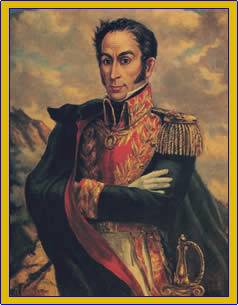
When he was 19 he got married but this marriage did not last long for his wife had died only after a year of their marriage upon his return back to Venezuela. He soon returned to Europe but this time his purpose was for travel especially in Italy and France. He used this time to study people like John Locke and even Napoleon. On the way back to Venezuela he stopped in the U.S.A. There he learned that they had just gained their independence from Great Britain. When he finally got back home he decided that it was South America’s turn to depart from Spain and gain their form of independence. He was going to lead them through it as well.
This is where the title "the George Washington of South America" began. In 1810 he seized Caracas and had to recapture it after he had come back from Great Britain for help. When he returned empty handed from there Bolivar had command of patriot army. First they defeated the Spaniards from Caracas but soon after they forced him to go back to modern day Colombia. In 1814 he got control of Bogota with help from the Colombian armies. Though they had win their many other defeats to come due to lack of food and supplies.
Bolivar had moved onto Jamaica. When he had reached Haiti, Bolivar was able to assemble another force this time to go to Venezuela and this time they had captured control of Angostura. In 1819, after ridding Colombia of Spaniards, Colombia had been liberated. On December 17 1819 he became president of the congress that had organized Colombia. Soon he took down the Spaniards that were in Venezuela in June 24 1821. Soon Ecuador became under his control rather than Spain’s. He soon became a dictator of Peru after meeting with another Liberator, Antonio Jose de Sucre. Together they led the final battles fought in this revolution and it had finally ended on December 9, 1824. The upper portion of Peru is now what is called Bolivia after what he had done for South America he deserved to have a country named after him.